
Dubai continues to amaze the world with the scale of its development. Recently, one of the Middle East’s largest developers, Majid Al Futtaim, signed an agreement to build a new residential complex in the Dubai South district. The investment is staggering — 62 billion dirhams, or nearly 17 billion US dollars. This is one of the most significant deals in the emirate’s history and promises to redefine what comfortable urban living near a world-class transportation hub truly means.
The Scale Is Astonishing: 22 Million Square Feet of New Life
Imagine a territory large enough to accommodate hundreds of football fields. That is the scale of the new complex. For comparison, this equals the area of several central districts of Dubai combined into one integrated project. There will be no chaotic urban development, as often happens in major megacities. Everything is based on a unified master plan combining residential neighborhoods, retail zones, and leisure spaces.
A key feature of the development will be a massive shopping mall designed not merely as a retail destination. Developers envision it as a complete lifestyle and entertainment hub for both residents and visitors. In addition to stores, the complex will feature restaurants, entertainment areas, cinemas, and possibly even amusement parks. Majid Al Futtaim is already renowned for its shopping centers across the Middle East — most notably Mall of the Emirates with its famous indoor ski slope. It is expected that the company will bring its best expertise to this project as well.
Who is this city being built for? Primarily for Dubai’s rapidly growing population. The Dubai South district is already experiencing active development and attracting professionals from the aviation and logistics sectors. However, the complex is also designed for residents of neighboring districts who will gain access to new high-quality infrastructure. According to experts, demand for housing in Dubai South will continue to rise — especially considering forecasts that the aviation sector could contribute more than 30% of Dubai’s GDP by 2030.
The Airport as a Magnet
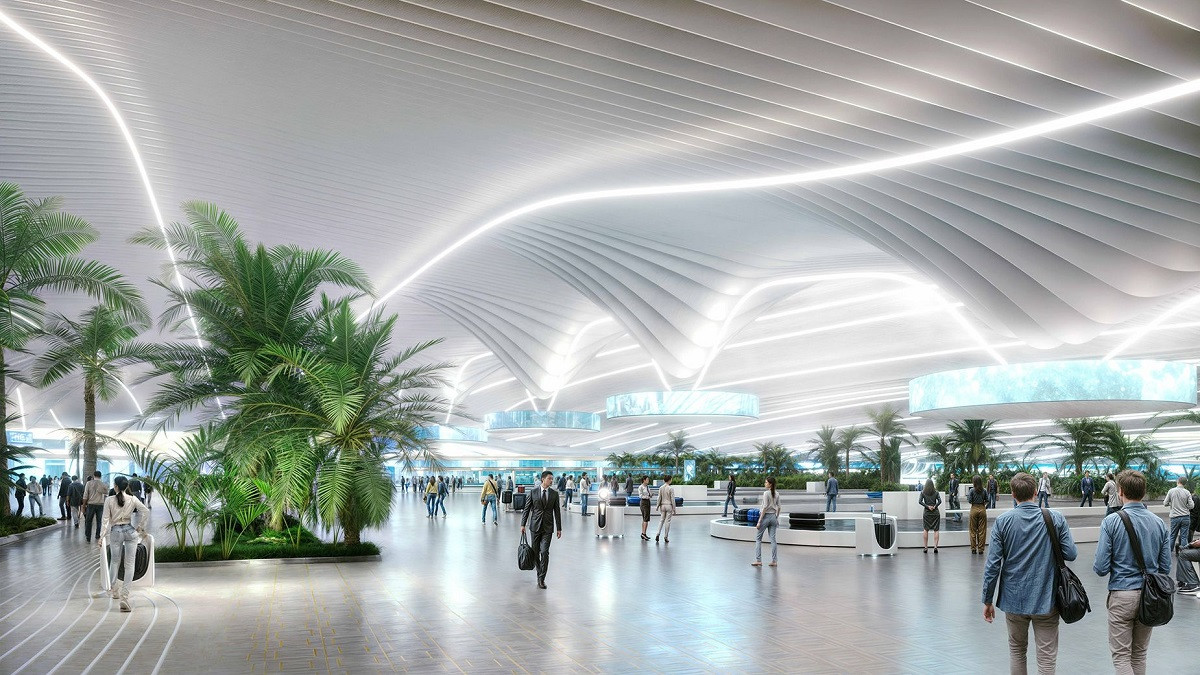
The project’s greatest advantage is its proximity to Al Maktoum International Airport. This airport is not simply another aviation hub. Once completed, it is expected to become the largest airport complex on the planet. The scale is extraordinary: five parallel runways, 400 boarding gates, and passenger traffic capacity of 260 million people annually. For perspective, Dubai’s current main airport, DXB, serves around 90 million passengers per year. The new hub will be nearly three times larger.
But the story is not only about size. An entire ecosystem is forming around the airport. Authorities have already approved a metro line extension and a station for the national Etihad Rail network, which will connect Dubai South with the rest of the emirates. This means residents of the new development will be able to travel quickly not only to central Dubai but also to Abu Dhabi, Sharjah, and other cities.
Construction of the airport is already progressing rapidly. Sheikh Mohammed bin Rashid Al Maktoum, the ruler of Dubai, personally approved the 128-billion-dirham expansion plans. In addition, construction has recently begun on a giant Emirates engineering complex worth 5.1 billion dollars, capable of servicing up to 28 wide-body aircraft simultaneously. All of this will create tens of thousands of jobs and generate enormous demand for housing near workplaces.
The new Majid Al Futtaim project fits perfectly into this broader vision. Residential districts will be connected to the airport and key transport routes, making the area one of the most convenient places to live in Dubai. Nearby logistics hubs and economic zones ensure that apartments and houses here are unlikely to remain vacant.
What This Means for the Economy and Real Estate Market
The signing of such an agreement sends a powerful signal to the market. An investment volume of 62 billion dirhams automatically elevates the project to national significance. Construction is expected to provide a major boost to several sectors simultaneously, including retail, tourism, residential construction, and commercial real estate.
For real estate investors, the project opens entirely new opportunities. Historically, housing prices in areas surrounding major transportation hubs tend to grow faster than the city average. Experts are already forecasting property price growth of 15–20% in Dubai South in the near future. The reason is simple: a huge number of aviation and logistics employees will seek housing close to work, creating strong and stable demand.
In addition, the development contributes to the economic diversification strategy that the UAE has been actively pursuing. By creating multifunctional urban centers instead of merely “sleeping districts,” Dubai reduces dependence on oil revenues and builds a sustainable urban environment attractive to international professionals and their families.